The Luddites Were Right. That's Not the Compliment You Think It Is.
Everyone says AI won't replace you. A person using AI will. That's a nicer story than what actually happened during the Industrial Revolution, and we should probably stop telling it.
The Luddites Were Right. That's Not the Compliment You Think It Is.
Everyone keeps saying the same thing about AI and jobs: "Don't worry. New technology always creates more jobs than it destroys. Just look at the Industrial Revolution."
They're not wrong. They're also not telling you the whole story.
#What Actually Happened to the Weavers
In the early 1800s, handloom weavers in Britain were skilled tradespeople. They understood their craft end to end, controlled their output, set their pace, worked from home or small workshops. It was dignified, reasonably well-paid work. Then steam-powered looms arrived in factories and produced cloth faster and cheaper than any human hands could manage. By 1820, there were roughly 240,000 handloom weavers in Britain. By 1850, POOF! the trade was functionally gone.

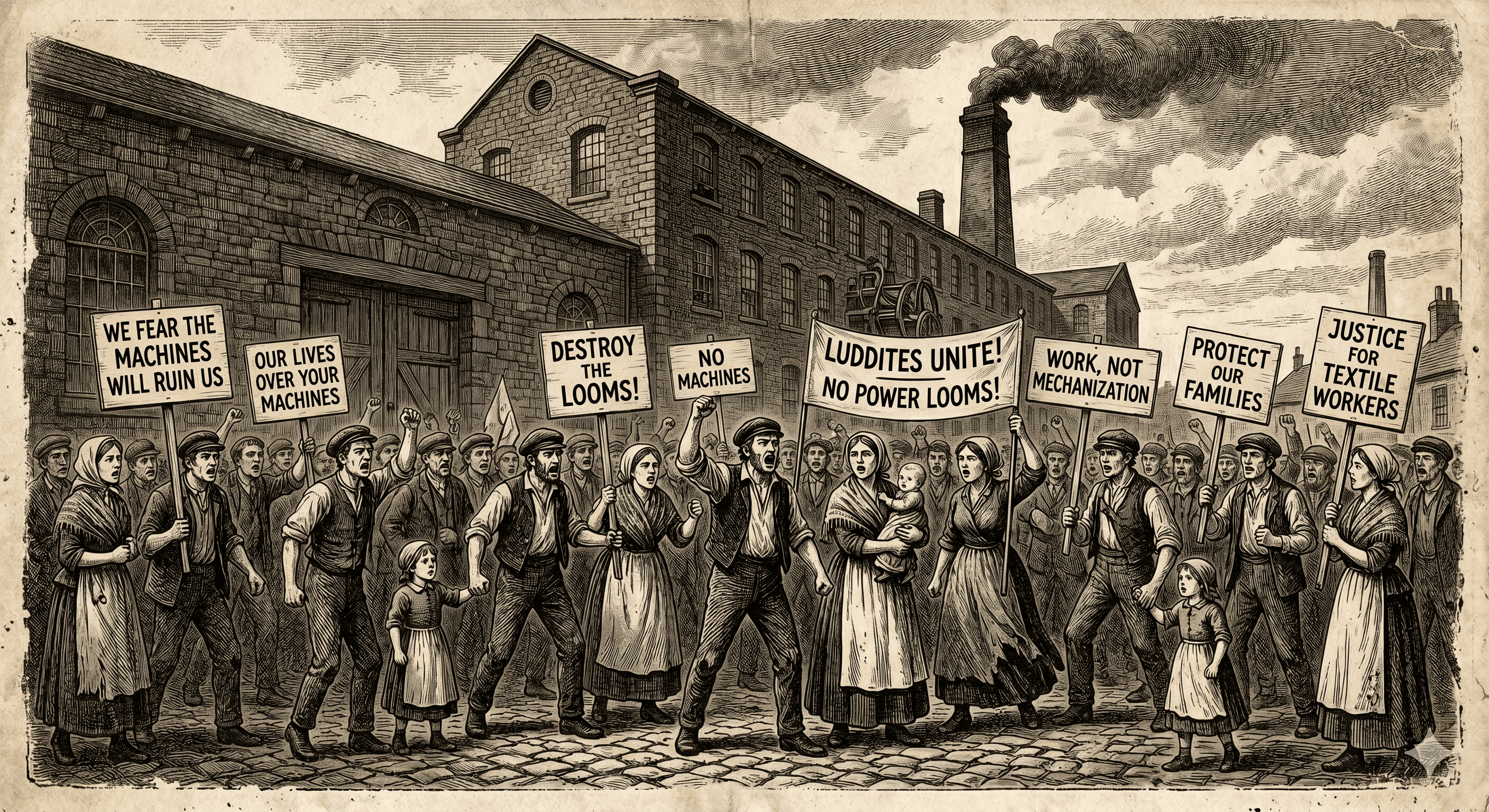
The Luddites, the movement you've probably heard of as a byword for being scared of technology, were largely these same workers. Skilled textile craftsmen who organised to destroy the machinery replacing them between 1811 and 1816. They get mocked in hindsight. They shouldn't be. Their diagnosis was correct: the machines did take their jobs. What failed them wasn't their instinct. It was that nobody gave them a third option.
Here's the part that doesn't make it into the optimistic category in this story: most workers who "adapted" to steam-era factories didn't move up. They moved sideways or down. A handloom weaver who became a factory engine minder (watching a pressure gauge, pulling a lever when it went red) didn't reinvent himself. He traded craft mastery for machine dependency. He survived. He didn't thrive. (If you've ever sat in a Monday morning ops meeting wondering why everyone looks like they're serving a sentence, you've seen this dynamic in person.) And the workers who couldn't even make that shift, typically older workers without the flexibility younger ones had, often ended up in unskilled physical labour or out of the workforce entirely.
New jobs did emerge. Engineers, mechanics, railway workers, factory managers: by 1851 over 40% of Britain's workforce had moved into industrial occupations that hadn't existed a generation earlier (Economic History Society, 2020). But those jobs largely went to people who were already positioned to grow into them, not to the weavers whose livelihoods had just collapsed.
#The Failure Wasn't Technological. It Was a Timing Problem.
The steam era gave displaced workers two options: move toward the machine and likely get deskilled, or resist and lose entirely. There was no early warning system. No way to look at your specific craft and ask: how exposed am I, and how long do I have? Workers found out their role was obsolete when the factory opened down the road. By then it was too late to do much about it.
That's the actual lesson from the Industrial Revolution that applies right now. Not "don't panic, it worked out fine" (it didn't work out fine for a lot of specific people), but rather: the workers who suffered most were the ones with no lead time and no pathway.
#The Difference This Time
AI is compressing the industrial revolution's timeline from decades into years. That's the honest, uncomfortable part of this comparison. "Humans always adapt" is true at the civilisational level. It's less reassuring if the adaptation window is three years and you're 45 with a mortgage and adult kids hanging at your neck.
But here's what's genuinely different: we have the diagnostic tool the weavers never had. You can use machine learning right now to analyse which roles in your business or your industry are most exposed to automation, how quickly, and what adjacent skills would reposition someone from target to operator. The irony is that the technology people are afraid of is also the best tool available for understanding your exposure before it becomes a crisis.
This isn't theoretical. South African businesses are already navigating this. The administrative roles, the data capture jobs, the basic customer service functions: these are compressing faster than most owners want to admit. The question isn't whether this affects your team. It's whether you find out proactively or reactively. And if it's reactively, you're not just losing a role, you're losing the time and money it takes to replace institutional knowledge you didn't realise you were sitting on.
#The Business Case for Upskilling Your Team Now
The factory owners who came out of the steam era strongest weren't the ones who replaced workers fastest. They were the ones who retrained the right people early and held onto institutional knowledge while their competitors were busy hiring from scratch.
That logic is sharper in South Africa than almost anywhere else. Recruitment is expensive, the skills pool for AI-adjacent roles is thin, and a new hire who already knows your business is worth more than an AI-fluent stranger who doesn't. Your existing team knows your clients, your processes, your quirks. That context has real value, but only if the people carrying it aren't made redundant before you think to invest in them.
Upskilling doesn't mean sending everyone on a six-month data science course. It means identifying which roles in your business are most exposed, finding the people in those roles with the appetite to grow, and giving them structured exposure to the AI tools already touching their work. That's a six-week process, not a six-month one. The cost of not doing it is a lot higher than the cost of doing it badly.
The businesses that will struggle aren't the ones that can't afford AI. They're the ones that wait until the pressure is so high they have no time to bring their people with them.
#The Third Option the Weavers Never Had
A factory engine minder in 1830 was deskilled by the machine. An AI overseer in 2026 is not. The human-in-the-loop role, the person who understands the process well enough to supervise, correct, and improve an AI system, carries more leverage than the role it replaces, not less. That's a fundamentally different dynamic to what happened in the textile mills.
Someone who currently does data processing and learns to manage and quality-check an AI agent doing that same data processing has not been replaced. They've been promoted, in every meaningful sense, without anyone changing their job title. That positioning is available right now. It won't be available indefinitely.
The Luddites were right that the machines would take their jobs. What they couldn't do was use those same machines to see it coming and move first. You can.
Pixel Nomad helps South African SMEs figure out where AI fits in their business, and where it doesn't. If you want to understand what this looks like for your team specifically, start here.
Seb
"Agentic full-stack software developer and founder of Pixel Nomad. I help South African SMEs build fast websites, custom AI agents, and automated systems that work while you sleep."
Discussion
Loading comments…