How a Cape Town Furniture Maker Hired an AI Agent
When every product listing means hours of photography briefs, copy rewrites, and SEO guesswork, something has to give. For Cross Grain Furniture, that something was the agency retainer.
If you run a small manufacturing or product business in South Africa, you already know the drill. You spend months perfecting your craft, you build something genuinely beautiful, and then you have to somehow convince the internet that it exists. So you hire an agency. Or a freelancer. Or your sister's boyfriend who "does social media stuff."
The result is usually the same. You are paying a monthly retainer, chasing someone for a product photo that looks nothing like your actual product, and rewriting descriptions that sound like they were translated from corporate English into corporate English again. Meanwhile your WooCommerce store has seventeen products stuck in draft because nobody got around to them.
This was roughly the situation at Cross Grain Furniture Design, a Cape Town-based custom furniture studio that makes genuinely exceptional pieces. The craftsmanship is there. The backlog of unlisted products was also there.
#Enter the Agent. No CV Required.
What we built for CGFD is what we call an E-Commerce Manager Agent. It is not a chatbot. It is not a widget on your website that says "Hi! How can I help?" and then fails to help. It is an orchestrated AI system that quietly runs on a Telegram bot.
Think of it as the digital operations manager you always wanted but could never justify the salary for. Except it works on Sundays.
"It checks what needs doing, gets it done, and sends you a message to approve. That is it. You stay in control without staying in the weeds."
#How the System Actually Works
Few times a day, the orchestrator agent wakes up and checks its orchestartor board for messages and tasks given by the team. This is where the Cross Grain team drops raw product information: New product name and brief description,dimensions, materials, the story behind a piece, reference images or direct photos. No formatting required. Just the facts.
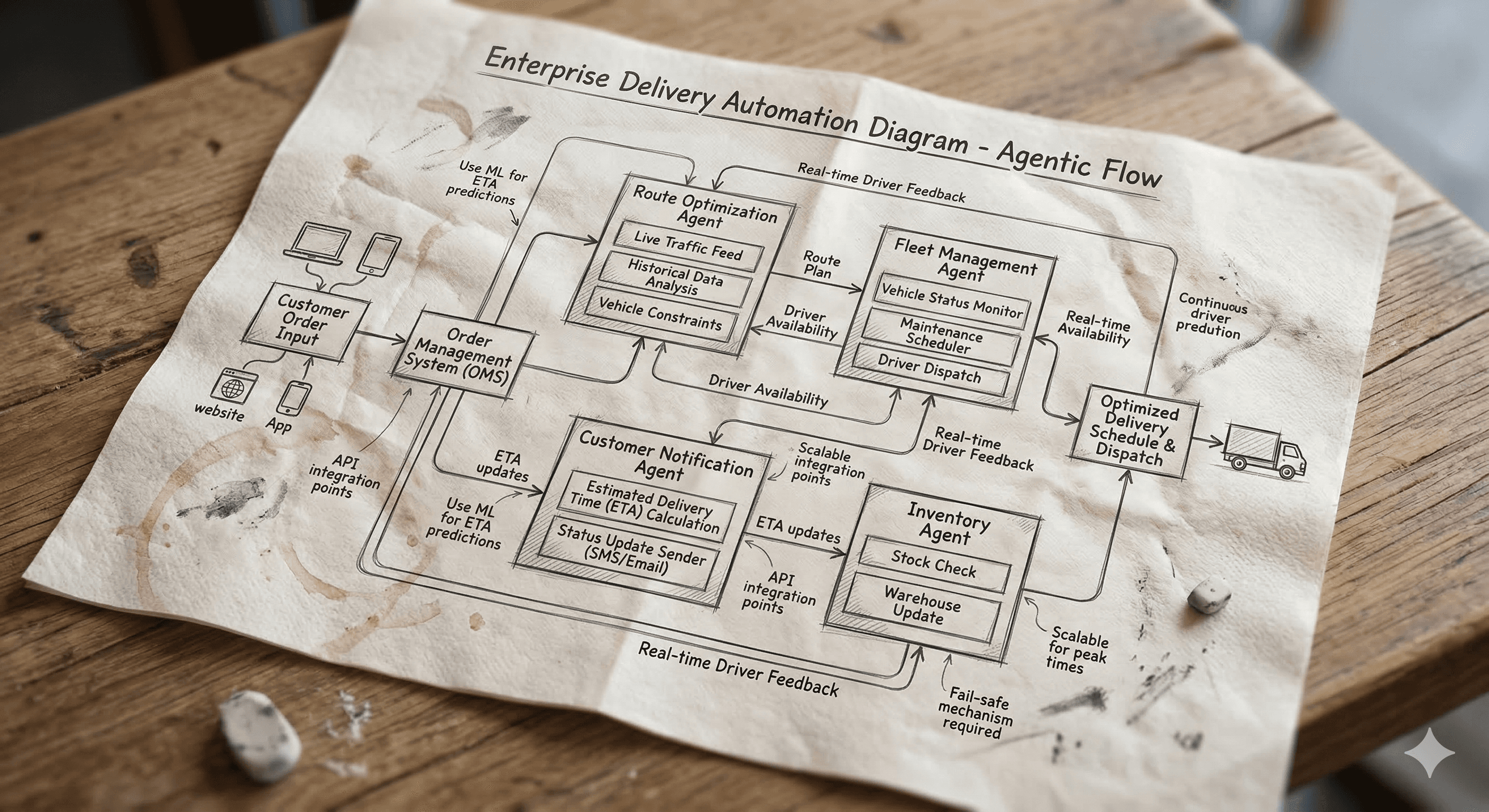
From there, the agent delegates to a set of specialised subagents, each with a specific job. Here is the flow:
- Orchestrator checks the orchestrator board. New product info detected. The manager spins up and delegates tasks to the relevant subagents.
- Image subagent generates on-brand product visuals. Guided by the Cross Grain Furniture brand style and product reference images and documents (single source of truth, read only directory). No photographer, no repetetive briefs, no back-and-forth over what "warm and natural" means.
- Copywriting subagent drafts the product description. Brand voice, tone guidelines, and the product detail all go in. Something that actually sounds like Cross Grain Furniture Design comes out.
- SEO subagent optimises the listing. Page title, meta description, keyword targeting relevant to furniture buyers searching in South Africa. Done.
- The product is saved as a WooCommerce draft. Nothing goes live without human eyes on it first.
- An approval Telegram message is sent to the team. Review it. Tweak it if you like. Approve it. Publish. That is the whole process.
The entire thing takes less than 5 minutes. No one has to go trough those overwhelming WooCommerce UI boxes. No one has to manage a project in Asana or chase a freelancer on WhatsApp at 11pm. It just happens.
#The Part Where We Talk About Money
South African SMEs operate in a different reality to the Silicon Valley case studies you read online. Budget is tight. Rand-dollar exchange rates make SaaS subscriptions feel like a personal attack. And the idea of spending R15,000 a month on a digital agency when your margins are already under pressure is genuinely painful.
Here is a rough comparison of what the old model costs versus what the agent model costs:
| Traditional Agency / Freelancer | AI Agent Model (Pixel Nomad) | |
|---|---|---|
| Setup | — | Custom quote (once-off) |
| Monthly retainer | R8,000+/mo | Fraction of the above |
| Product photography | R3,000+ per shoot | Included in agent workflow |
| Copywriting | R300–R800 per listing | Included in agent workflow |
| SEO consultant | R3,500+/mo | Included in agent workflow |
| Your time | Managing all of them | 15 minutes a day reviewing drafts |
| Monthly total | R15,000+ | Significantly less |
I am not going to throw fake numbers at you. Every business is different. But the directional point stands: once the agent is built and running, the ongoing cost is orders of magnitude lower than paying humans to do repetitive digital operations tasks that a well-designed system can handle reliably.
#What This Is Not
Before the comments section writes itself, let us be clear about a few things.
This is not a system that replaces your brand judgment. It works because it is trained on your brand guidelines, your tone of voice, your product information. Garbage in, garbage out still applies. If you dump three bullet points, a blurry photo and a thumbs-up emoji into the onboarding doc and expect magic, you will get appropriately mediocre results.
It is also not fully autonomous. The approval step is intentional. You stay in the loop. The agent handles the 80% that is repetitive and time-consuming. You handle the final 20% that requires your taste and judgment. This is the correct division of labour.
Cross Grain Furniture Design did not hand over their brand to a robot. They handed over the admin to a robot. Their creative vision, their quality standards, and their customer relationships stayed entirely with them. The agent just made sure the store caught up with the workshop.
#Why South African SMEs Are Perfectly Positioned for This
There is an irony here. South African small businesses are often the last to adopt technology and yet they have some of the most compelling reasons to do so. Skills are expensive. Reliable freelancers are hard to find and even harder to retain. And the economic reality means that operational efficiency is not a nice-to-have, it is survival.
AI agent systems are not a luxury for tech companies in Johannesburg. They are a practical solution for the joiner in Woodstock, the ceramicist in Stellenbosch, the furniture maker in the Southern Suburbs who has forty pieces in the workshop and eleven on the website because nobody had time to write the listings.
The technology is here. The implementation is what most businesses are missing. That is what we do at Pixel Nomad.
#One More Thing Cross Grain Furniture Design Got Back
Time. Specifically, the kind of time that was previously spent on WhatsApp threads with the agency, explaining for the third time what "warm, natural, premium" means as a brand direction.
When your digital operations run themselves, you get to spend that time on the thing that actually drives your business. For CGFD, that is building furniture. For you, it might be something entirely different. The point is that it should be yours to decide, not eaten up by operational overhead that a well-built agent could handle before you have had your first coffee.
Your store should work as hard as you do. If your WooCommerce store has a graveyard of unpublished products, or you are paying an agency more than you should for work that could be automated, let us talk.
Seb
"Agentic full-stack software developer and founder of Pixel Nomad. I help South African SMEs build fast websites, custom AI agents, and automated systems that work while you sleep."
Discussion
Loading comments…